Neighborhood Power
A short guide to hyperlocal government.
On the Lighthouse reader survey earlier this summer, many people said the following:
- They wanted more coverage of the local community board.
- They felt frustrated by a feeling that city government is slow to respond.
- They wanted to know more about how to get involved in the neighborhood.
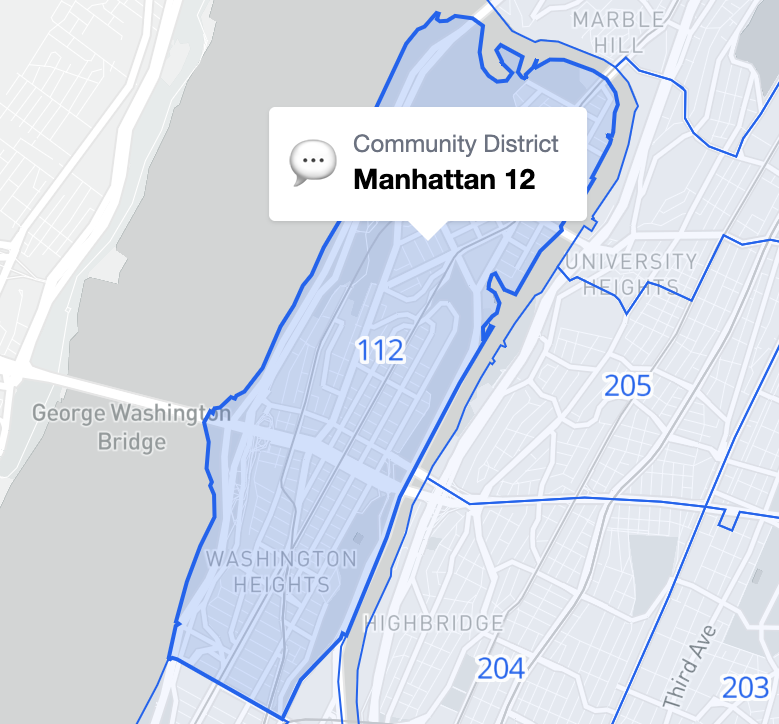
With all three of those things in mind, I wanted to take an issue to talk about local government up here in the Heights — specifically, Community Board 12-Manhattan and Community Education Council 6.
A lot of people have only a vague idea of what these groups do. And it's not always clear how much power they have.
But if you want to actually get things done in the neighborhood, or if you just want to know more about what's going on, these groups can be important resources.
The first step is understanding what they actually do.
Community Boards
The community board has 50 volunteer members, appointed by the Manhattan Borough President, and they meet regularly to discuss local issues in Washington Heights and Inwood. They also serve on committees focused on topics such as parks, traffic and transportation, and public safety.
These meetings are open to the public and streamed online. They mostly take place on weekday evenings.
Community Board 12 doesn’t pass any laws. Its role is fully advisory. “We are first and foremost a voice for the community,” said Anthony Viola, the board’s current chair.
Among their roles:
- Officials from city agencies come to CB12 meetings and present plans for upcoming projects in the neighborhood. Board members ask questions and give them feedback.
- The board passes resolutions making specific requests of city agencies — for example, asking the Port Authority to reopen Dolphin Park.
- They list funding priorities for the neighborhood, which city officials consult when developing each year’s budget.
- They give advice to city officials on whether to greenlight certain construction projects.
- They advise regulators on whether or not to approve liquor and cannabis applications.
- They have a small staff that helps constituents solve local problems.
If you can get their buy-in, the board can also act as a megaphone for specific community complaints. (There's a real difference between calling 311, and calling 311 plus organizing your neighbors to come and kvetch at CB12 meetings.)
The board is also a kind of farm team for future politicians. Our U.S. Representative, Adriano Espaillat, once served on CB12. So did neighborhood notable Mark Levine, the city comptroller.
“The most local form of democracy”
How did we get community boards? I recently called up Robert Pecorella, a professor of government and politics at St. John’s University in Queens, to ask about the history. Pecorella said they were created as a “reaction against what I think it’s fair to call extreme centralization of the ’50s and ’60s.” Think New York City in its Robert Moses era.
Reformers in the 1970s took a different approach, Pecorella said. “In a number of cities across the country, community board-type projects were undertaken as a way to say to the community, ‘You know, we care about what you have to say.’”
It’s not always clear that policymakers do care, and there’s long been a debate over the extent to which community boards only exist to make people feel heard. Longtime members told me that policymakers often do listen, and that they’ve seen cases where the board gets results. (Not everyone agrees that’s a good thing; some critics say community boards tend to obstruct development in the city.) Community boards can also inspire a certain bright-eyed civic hopefulness. “It’s the most local form of democracy,” said Sarah Sayeed, who runs the city’s Civic Engagement Commission.
People have to apply for seats, and the borough president selects a group that, in theory, represents the neighborhood.
Viola, the current chair, is 29 years old. He found his way to the board after interning in the office of then-City Council Member Mark Levine, where he worked directly with community boards. “I was really inspired by some of the conversations I was hearing,” he told me. He applied to join Community Board 12 and was rejected twice before getting a seat. Today, on top of his day job, he spends around 30 hours per week on board business, as a volunteer.
The Community Education Council
If Community Board 12 is (sort of) our town council, Community Education Council 6 is our school board.
These councils are relatively new. Once upon a time, districts had school boards that wielded considerable power. (Meetings could get contentious; a longtime education activist in the neighborhood recently told me about attending a local school-board meeting where a car was firebombed.) In the early 2000s, then-Mayor Michael Bloomberg consolidated control under the mayor — a policy that remains controversial — and, instead of school boards, individual districts got CECs.
Like community boards, most of what they do is advisory. Their members, who are elected, do have one legal power, which is to approve the zoning boundaries for district schools.
How much power do they wield otherwise? Luis Camilo, a longtime CEC6 member who has also served as president of the group, told me their influence is pretty limited, and requires a lot of pressure on policymakers. “It takes patience, perseverance, and we have to keep advocating and pressing and doing resolutions,” he said. “After a while, they get embarrassed. They have no choice but to throw a little bone to us. That’s about it. But it’s a lot of fight, and we don’t get paid.”
Walking In
While CECs and Community Boards have limited legal authority, part of their appeal is in their openness. Anyone can walk into a meeting, grab a speaking slot, and have the ear of actual city officials. There’s also a lower threshold to join than, say, city council: the top vote-getter in the most recent CEC6 election had fewer than 100 votes; 30 percent of applicants last year got a slot on CB12.
When I talked with Pecorella, the St. John’s professor, I told him about the recent debate over Zeta Charter Schools’ proposed campus at 181st and Broadway. Zeta had dispatched executives and lawyers to multiple Community Board 12 meetings; the CEO of the charter network had shown up on a weekday evening and sat through a long meeting of the CB12 Youth & Education Committee, just to present for a few minutes.
After all that, the board still opposed Zeta’s proposed project. It’s not clear whether city officials will follow their advice and block the project.
There are two ways to interpret these events. Zeta’s attention could be a sign of the board’s power. But if officials ignore the board’s advice, that could also be seen as a sign of its impotence. Pecorella sounded delighted with this story; he said it was “one of the most hopeful things I've heard about politics in a long time.” I was surprised, even a little skeptical. Why?
It was meaningful, he said, that the charter-school network had at least felt the need to engage with the board, to seek their input and approval. “That’s power!” he said. “That’s political power.”
Have a story tip? Email mhschulson@gmail.com, or message me on Signal (Schulson.17) or WhatsApp (646-279-6952).