Arrival of the Amazon Trucks
Amazon is ubiquitous in the neighborhood. Not everyone's happy with their delivery model.
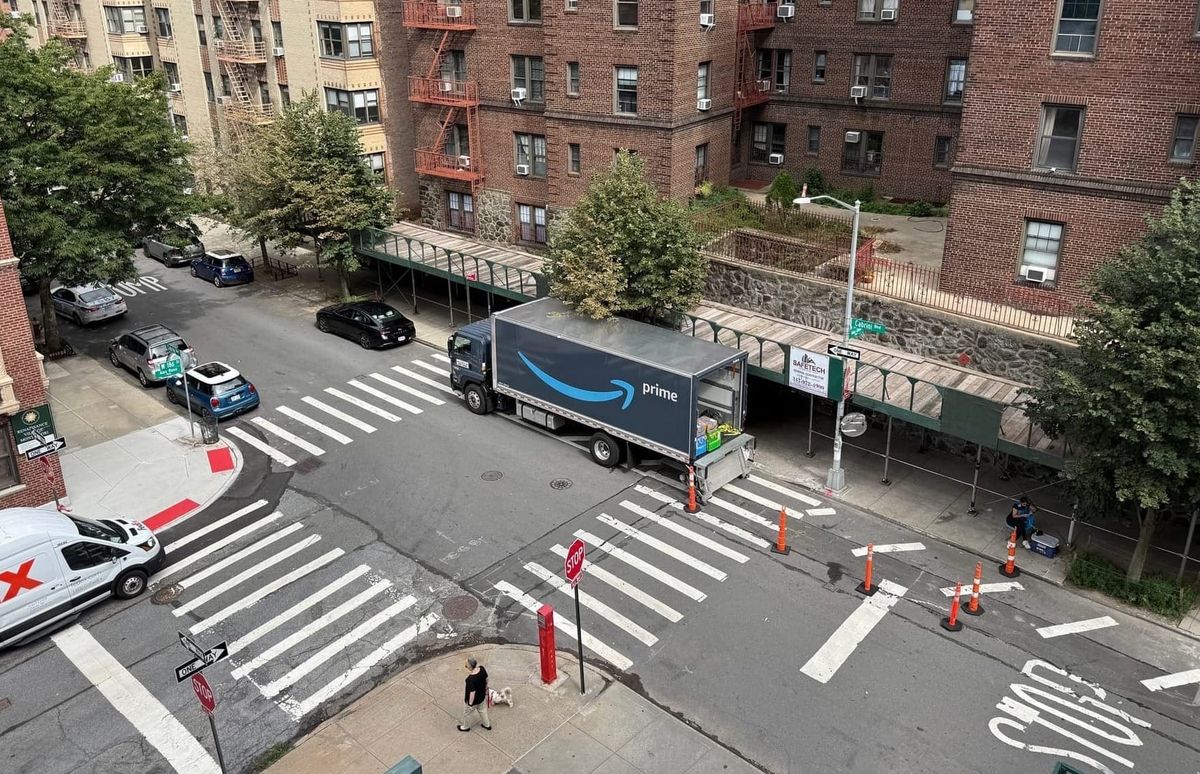
The trucks arrive in the Heights around midday, filled with mousetraps or phone chargers or scented candles or whatever else people buy on Amazon.
They operate differently from other delivery vans in the neighborhood. The Amazon trucks tend to return to the same spot day after day, sometimes for weeks on end. Workers create temporary staging grounds behind the trucks and on nearby sidewalks, loading packages onto carts. They camp out in one spot for hours, sometimes double-parked on busy streets.
Unsurprisingly, some neighborhood residents are complaining about how a powerful company like Amazon is using public space in the neighborhood.
The Crosswalk
This drama recently peaked in Castle Village, the multi-tower complex on Cabrini Boulevard.
One resident, John White, told me that he first noticed the Amazon truck in August, parked at Cabrini and 186th Street. White has a history with that intersection: A few years ago, he and his then-infant son were almost hit by a car there. Afterward, he helped persuade the city to put in a stop sign.
Now the Amazon truck was blocking the crosswalks.
Neighbors on Cabrini started swapping messages. Some complained that workers were smoking pot and playing loud music. “Let's just say it's not the music that people, the seniors in Castle Village, or even I would listen to,” Elizabeth Kellner, who lives in the complex, told me.
Others were mostly focused on safety. “I get it, that Amazon has a job to do,” White told me. But the arrangement looked unsafe and unfair. Amazon seemed to be using the street and sidewalk as a depot, instead of paying for space. “That is taking advantage of public space for corporate greed,” he said.
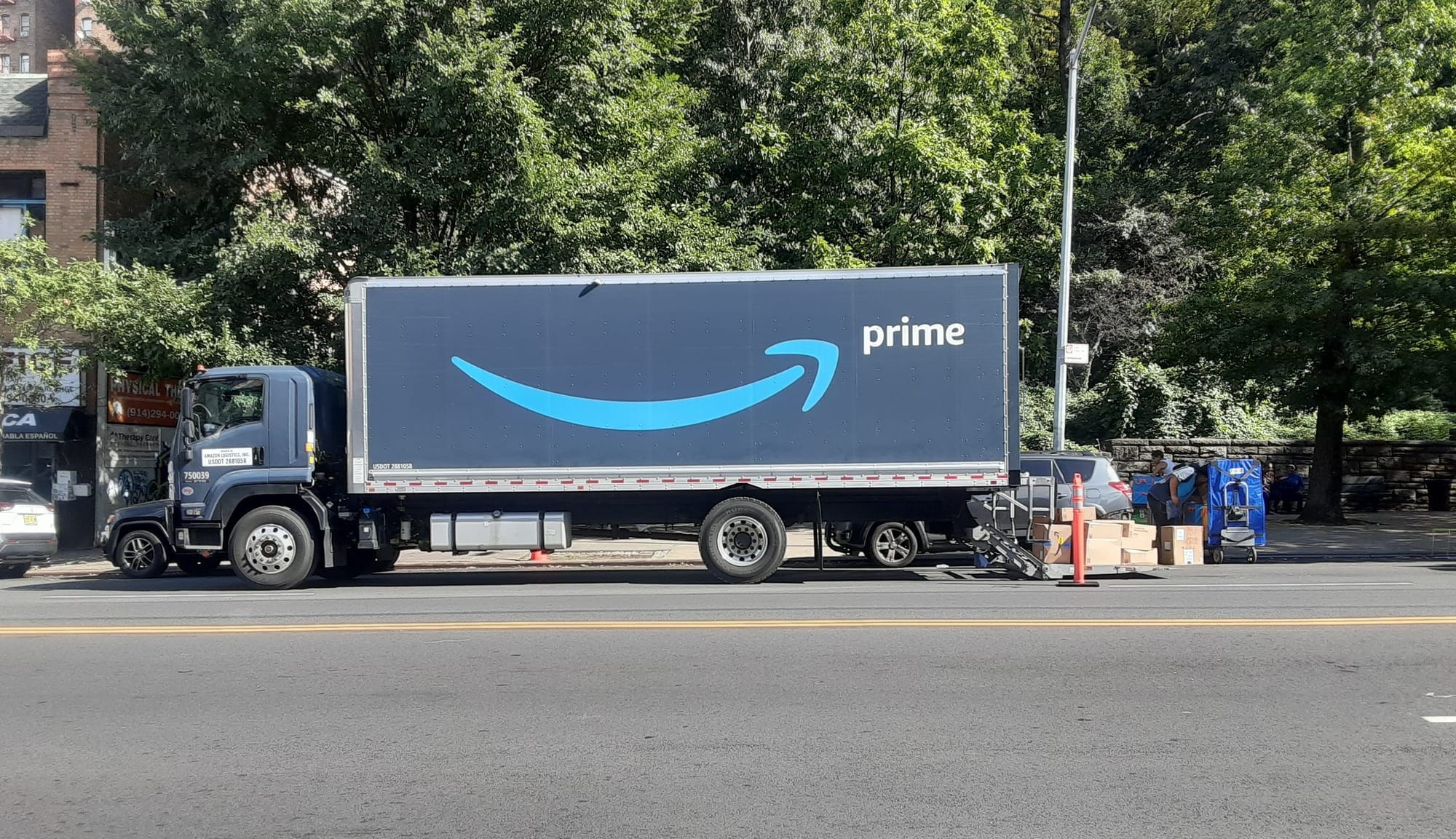
Residents started making 311 calls and contacting elected officials. White and a neighbor, Stephen Corson, went to a Community Board 12 committee meeting to raise the issue.
Those efforts may have worked: This week, I spotted the truck parked on Fort Washington Avenue — jutting out into traffic — rather than blocking crosswalks on Cabrini.
Drivers and Walkers
To handle its delivery operations in New York City, Amazon contracts with dozens of companies — called delivery service partners, or DSPs — that do the actual work of getting packages to apartment doors.
Critics of the model argue that it allows Amazon to avoid accountability for its effect on workers and city streets. Legislation in front of the city council would cut back the use of DSPs.
Opponents of the bill say it would harm local businesses and raise prices for consumers.
So how does the actual delivery process work? One truck driver told me he works for a DSP called Cornucopia Logistics. He picks up a load of packages each morning at a warehouse in Rutherford, New Jersey, and drives it to a designated spot in Upper Manhattan, called an anchor point.
There, he meets up with delivery workers called walkers, who load the packages onto carts and deliver them. On the day we spoke, he estimated he had brought 1,100 packages in his truck.
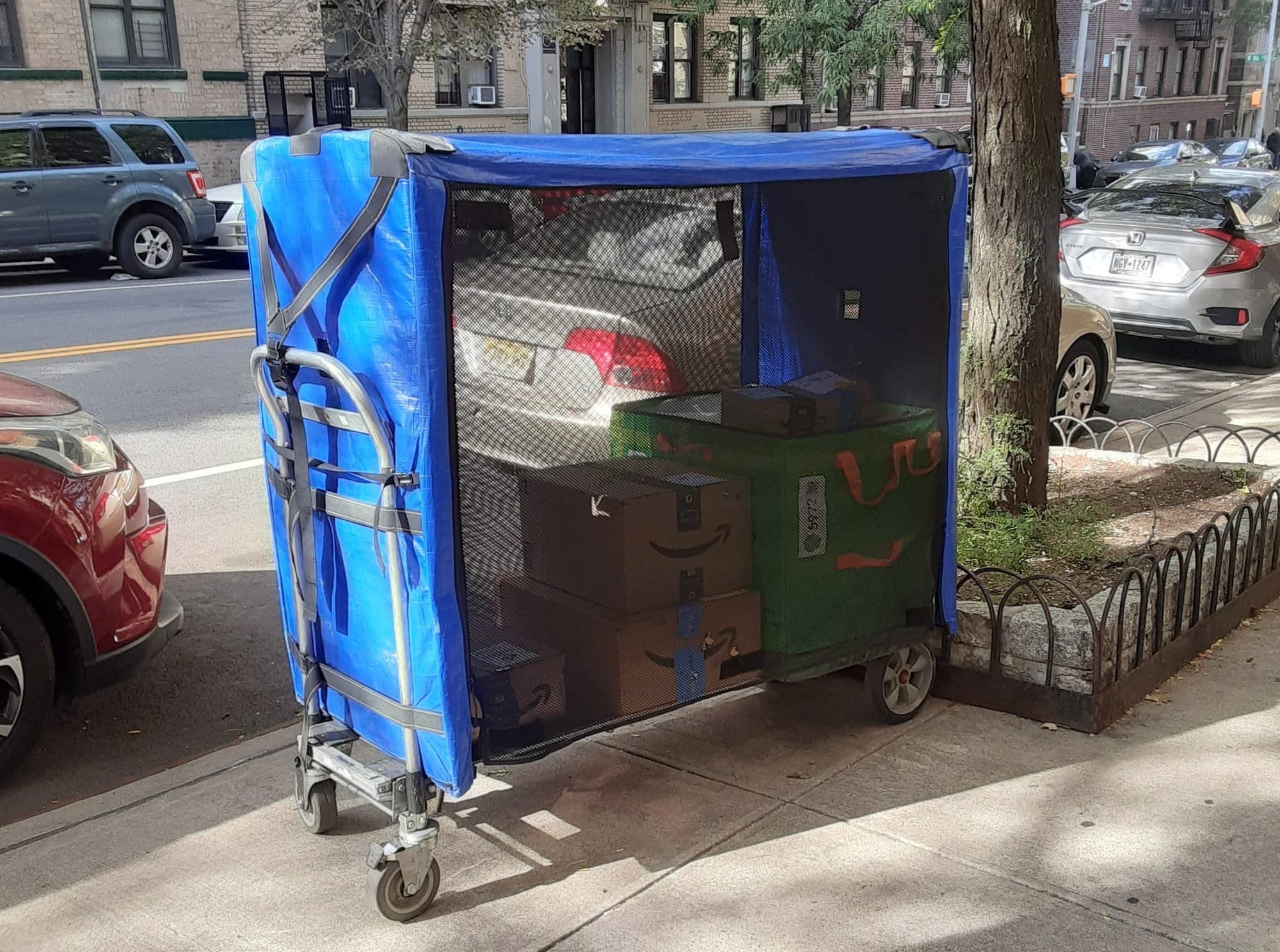
At another anchor point, I spoke with a walker who also works for Cornucopia. (He asked me not to print his name.) Each morning, he said, he checks the messaging app Telegram to find out his worksite. Work starts around noon, and the hours are uncertain. Some days they're done by late afternoon. Other times they work into the evening.
On the day we spoke, he said, he had 86 packages to deliver. The walker told me he makes $18.50 per hour, with benefits, and that his take-home pay is around $450 per week.
He acknowledged the community complaints: “I get that we’re intruding into that community space,” he said. And he expressed reservations about the whole arrangement. “Amazon washes their hands with the contractors,” he said.
"Real Logistical Challenges"
An Amazon spokesperson, Emma Crowley, referred most of my questions to New York Delivers, a coalition that includes Amazon and many DSPs. “We continuously look for ways to reduce the impact of deliveries on the neighborhoods we serve,” she wrote in an email.
A representative of New York Delivers sent back detailed answers from Mark Chiusano, the CEO of Cornucopia. Chiusano backed up most of the details the delivery workers had told me, but said the company recently raised starting pay for walkers to $19.50 per hour. The jobs “provide an accessible entry point into the workforce,” he wrote.
As for all those complaints about truck parking, he wrote that delivery in the Heights “comes with real logistical challenges, particularly when it comes to finding appropriate places for delivery vehicles to stop.” He argued that the model is less disruptive and more eco-friendly than one in which multiple delivery vans roam the neighborhood, parking at each delivery stop and clogging up streets.
At Least It’s Not Drones
City officials have proposed setting up microhubs: Designated zones for delivery vans to transition their stuff from big trucks to things like hand carts or cargo bikes.
The NYC Department of Transportation rolled out pilot microhubs further downtown in 2025. Earlier this year, a DOT official gave a presentation about the concept to the Community Board 12 Traffic and Transportation Committee. She received a chilly reception: Attendees worried that microhubs would take away parking spots, or that people would illegally park their private vehicles in the hubs.
Without microhubs or some other innovation, or more robust traffic law enforcement, it's not clear how much will change.
Kellner, one of the Castle Village residents, sounded sympathetic to her neighbors’ concerns. At the same time, she said, “we all know that many people in Castle Village benefit from this delivery method. We know what our lobbies look like at the end of the day, when there are piles and piles of packages.”
It could be worse: Kellner pointed to a recent article about a Texas suburb that’s swamped with 83-pound flying Amazon delivery drones.
“All these modern conveniences,” she told me, “come with a cost.”
Have a story tip? Email mhschulson@gmail.com, or message me on Signal (Schulson.17) or WhatsApp (646-279-6952).