Broadway's Saddest Park
Why has so much of Amelia Gorman Park been closed since 2017?
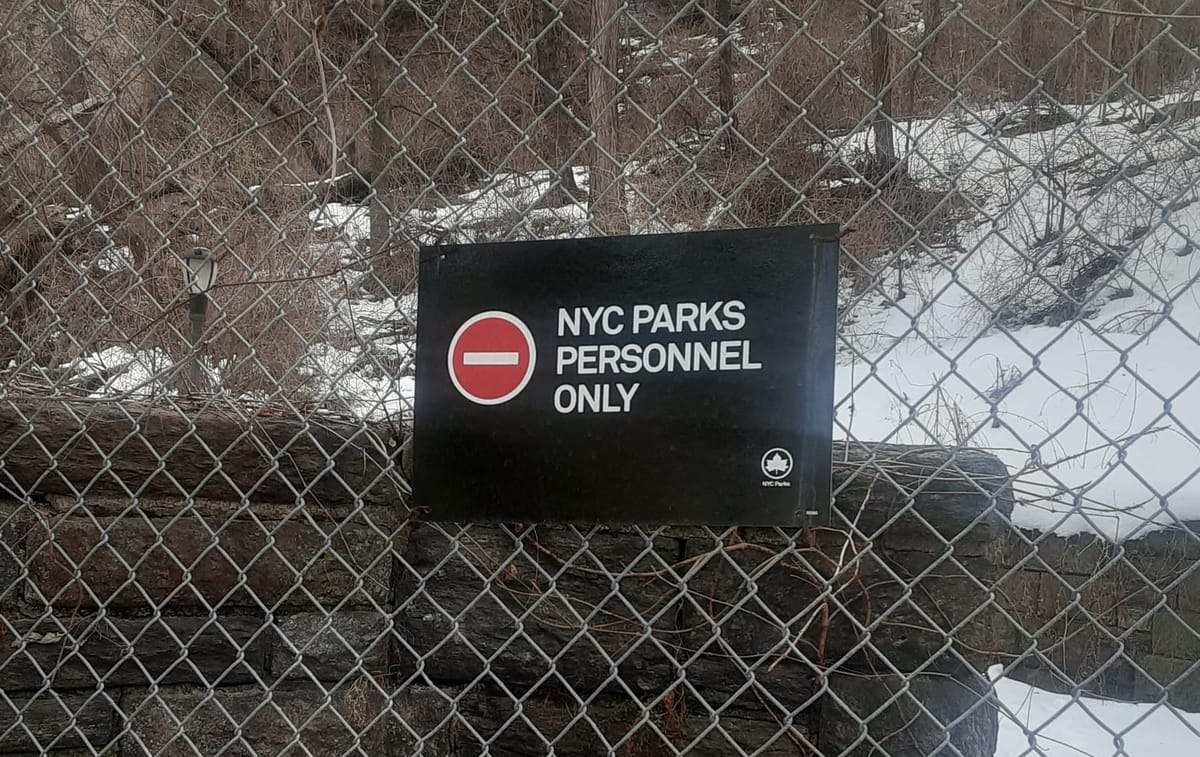
The last time Amelia Gorman Park was fully open to the public, Bill de Blasio was the mayor. Most current third-graders in the city had not yet been born.
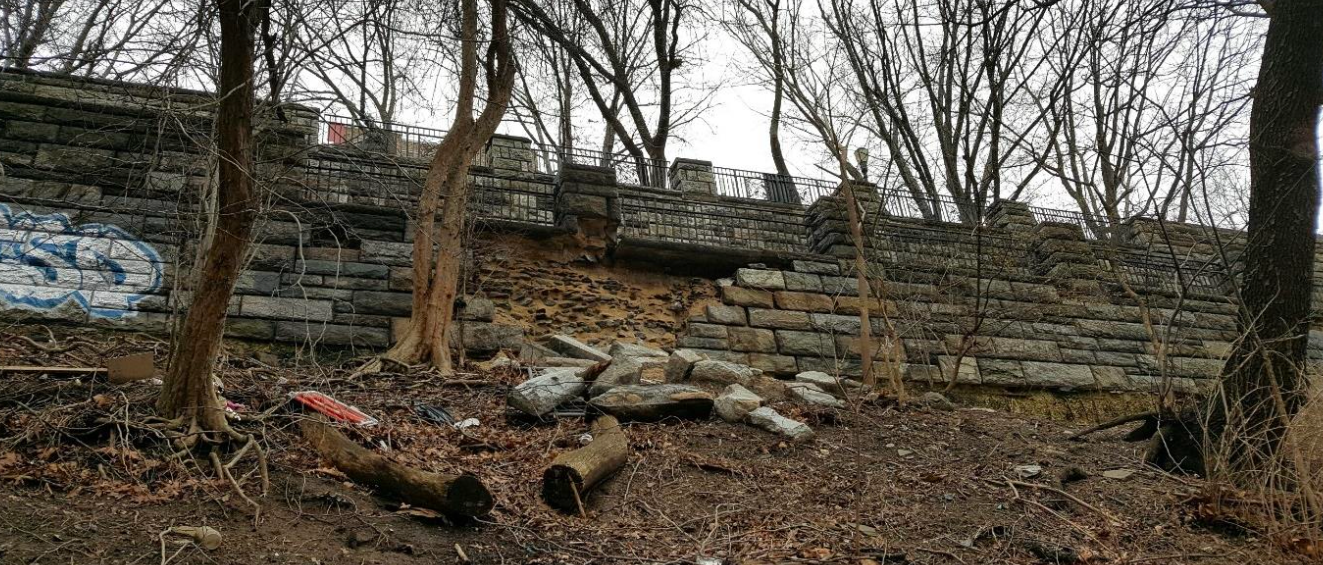
The 1.9-acre park slopes from Wadsworth Terrace down to Broadway, but most of it has been shuttered since a retaining wall collapsed in March 2017. Today, a large terrace at the top is open. Trash accumulates inside the rest of the park. The walk from Wadsworth Terrace to Broadway — once just a few hundred yards, through trees — is now closer to one-third of a mile.
Long-term closures of this magnitude are rare, said Mitchell Silver, an urban planner who served as de Blasio’s Parks commissioner, after reviewing details of the case. “I don’t know how this one slipped through the cracks.”
The Cracks
So what happened?
In the years before the closure, the city did invest in improvements to Gorman Park. But NYC Parks “never had all the money to do the full renovation of the park,” said Elizabeth Lorris Ritter, who chaired our community board’s parks committee from 2007 to 2011 and again from 2015 to 2023.
Then things fell apart. I was able to piece together a partial timeline from interviews and public records requests:
- March 2017. After heavy rains, Parks workers arrive at Gorman Park to find parts of a retaining wall have collapsed. In a report, they speculate that “chronic stormwater issues” had damaged the wall. Their verdict: “Engineering recommends immediate closure of the site.”
- July 2020. An engineering firm submits a detailed plan for fixing the wall. They estimate the project will cost at least $628,000.
- November 2020. Two Parks employees make a presentation to the Community Board 12 Parks Committee. They say the project is fully funded and ready to roll, and that construction should start soon and move quickly. “So that could be done by July?” someone asks. “Yes,” one of the Parks employees answers.
- February 2021. Engineers report that “the condition of the retaining wall further deteriorated” after they finished making a plan to fix it. They need more time and money to reassess the situation.
At this point, the documents I have are a little fuzzier. But the overall story seems to be this: NYC Parks thought they were ready to start renovations; once they got in there, they found the damage was worse than they had realized; cost estimates ballooned until the whole thing ended up back at square one.
Lorris Ritter compared delayed capital projects to a ripped pair of pants. “If you have a little hole and you don’t sew, it, pretty soon you have a very big hole. Now you need a whole new pair of jeans," she said. "If you had just fixed it, you’d have a cute little darned patch.”
According to NYC Parks, the project is now expected to cost at least $20 million.
Invisible Problems
None of that explains why the wealthiest city on the planet can’t fix a modest-sized wall made of rocks.
I ran a version of this question by John Surico, a journalist and researcher in Queens, who wrote a big report back in 2018 on parks infrastructure in the city. “The true problems that plague the park system are mostly invisible,” Surico told me — things like water mains and retaining walls that can be very expensive to fix.
NYC Parks doesn’t have much funding to maintain those big-ticket items. And when they break, there’s not a big, flexible pot of money that Parks can tap for repairs. Instead, Surico said, “the parks department has to basically go around with their hand out for money.” NYC Parks presents individual City Council members with a menu of needs in their districts, and asks them to provide funding from their discretionary budgets.
Council members have lots of projects to choose from. Retaining walls are not sexy. And even if the council member is all-in, they may only have a few million dollars to spend, which isn’t always enough for big projects. So NYC Parks cobbles together funding from a variety of sources — including borough presidents, the mayor, state and federal agencies, and nonprofits.
Only then can the actual design and construction process start. Thanks to the city’s slow procurement process, a contractor shortage, and other issues, that can also drag on for years.
But the Gorman rebuild isn’t even there yet. It’s still in the finding-the-money phase. Getting to a renovated park, Silver said, will take some time: “Looking at that park, and the fact the process didn’t start, you’re looking at 5 years plus.”
"We Have to Get This Done Before I'm Gone."
In the most recent city budget, City Council member Carmen De La Rosa secured $3 million toward the project.
In an interview with The Lighthouse, De La Rosa said she’ll try to get another $3 million in the upcoming budget cycle. But getting to $20 million will require buy-in from outside the City Council. De La Rosa said she’s exploring state and federal funding sources, and she said she brought up Gorman Park with the new Manhattan borough president, Brad Hoylman-Sigal. “It seemed like something he was very interested in collaborating on,” she said. “There was a lot of openness there.” (I asked Hoylman-Sigal’s office if they wanted to weigh in for this story but didn’t get a response.)
De La Rosa said Gorman is her parks priority, and she aims to round up the money needed to fix it before she exits her seat. “I’ve made it my mission to get this done before my term is up,” she told me. “I’m now in my last term in office. It’s four years. So we have to get this done before I’m gone.”
In the meantime, she said, she’s pushing to find safe ways to open up more of the park before construction is completed.
An NYC Parks spokesperson sent me a statement saying that they have “been working diligently to address the needs of the retaining wall and other parts of Amelia Gorman Park.” The statement said that the park requires a lot more than a new retaining wall: Crews need to rebuild paths and stabilize the slopes; “drainage, water, and lighting systems also need to be upgraded.” There are 50,000 square feet of plantings to restore.
For now, the park is full of trash. People who live nearby describe concerns about drug use there.
Claudia Vergara, a lifelong Heights resident, said she didn’t feel safe going through the park even in the years before it closed. Today, she often brings her grandson to the benches that line the park’s Broadway side. “In the summertime it looks a jungle,” she said. “Sometimes I’m sitting here, and I just see people come over the wall.”